
La Monte Young Marian Zazeela Jung Hee Choi
LEEUM 26 IV 29 SEOUL DREAM HOUSE
Sound and Light Environment
VIP Opening
Thursday, April 30, 2026
5 pm - 7 pm
Special Performance
RICE (1999): Sustained Frictional Harmonics Resonance Version
(in the style of La Monte Young's 1960 Studies Series) (2000, 2024)
Jung Hee Choi
Thursday, April 30, 2026 | 6 pm
Public Opening
Tuesday, May 5, 2026
10 am - 6 pm
Leeum Museum of Art
Inside Other Spaces: Environments by Women Artists 1956-1976
60-16, Itaewon-ro 55-gil, Yongsan-gu, Seoul, 04348, Korea
A collaborative Sound and Light Environment by La Monte Young, Marian Zazeela, and
Jung Hee Choi will be presented at Leeum Museum of Art, Seoul. The Korean premiere of
the Dream House, which is also the first Dream House installation ever presented
in Asia,
titled La Monte Young, Marian Zazeela, Jung Hee Choi Leeum 26 IV 29 Seoul
Dream House, opens
Thursday, April 30, 2026, and will remain on view through Sunday, November 29, 2026.
This version of the Dream House will feature the Young and Choi collaborative simultaneous sound environment presented within the Zazeela and Choi site-specific simultaneous light environment. The artists stated:
"The Base 9:7:4 Symmetry" and "Tonecycle" sound environment is another example of a Young and Choi collaborative sound work projecting the opposite paradigms in complementarity, where two sound environments will be simultaneous and harmonizing in one acoustic space, allowing the listener to experience the complex interrelationship of these two sets of intervallic frequency ratios. The sine waves in Young's The Base 9:7:4 Symmetry consist of long-sustained tones that remain constant and sound eternally without any change. In her writing, Choi articulates the opposing natures of the two sound environments. She explains:
La Monte Young pioneered the concept of extended time durations in 1957 and for over 60 years contributed extensively to the development of just intonation and rational number-based tuning systems in his performance works and the periodic composite sound waveform environments of the Dream House collaborations formulated in 1962 with Marian Zazeela. Presentations of his work in the U.S. and Europe, as well as his theoretical writings gradually had a wide-ranging influence on contemporary music, art and philosophy, including Minimalism, concept art, Fluxus, performance art and conceptual art. In L.A. in the '50s, Young played jazz saxophone, leading a group with Billy Higgins, Dennis Budimir and Don Cherry. He also played with Eric Dolphy, Ornette Coleman, Terry Jennings, Don Friedman, and Tiger Echols. At Yoko Ono's studio in 1960 he was director of the first New York loft concert series. He was the editor of An Anthology, which with his Compositions 1960 became a primary influence on concept art and the Fluxus movement. In 1962 Young founded his group The Theatre of Eternal Music and embarked on The Tortoise, His Dreams and Journeys, a large work involving improvisation within strict predetermined guidelines. Young and Zazeela helped bring renowned master vocalist Pandit Pran Nath to the U.S. in 1970 and became his first Western disciples. Described by Mark Swed in his October 2009 Los Angeles Times blog as "pure vibratory magic," Young's Just Alap Raga Ensemble, founded in 2002 with Zazeela and their senior disciple Jung Hee Choi, has become his primary performance vehicle. "For the past quarter of a century he has been the most influential composer in America. Maybe in the world." (Los Angeles Herald Examiner, 1985). "As the acknowledged father of minimalism and guru emeritus to the British art-rock school, his influence is pervasive" (Musician magazine, 1986). "Young is now widely recognized as the originator of the most influential classical music style of the final third of the twentieth century." (Strickland, Minimalism:Origins, 1993). "La Monte Young: Le Son du Siècle." (L'Express L'An 2000 Supplement, 1999).
Marian Zazeela is one of the first contemporary artists to use light as a medium of expression. Expanding the traditional concepts of painting and sculpture while incorporating elements of both disciplines, she developed an innovative visual language in the medium of light by combining colored light mixtures with sculptural forms to create seemingly three-dimensional colored shadows in radiant vibrational fields. Zazeela began singing in 1962 with La Monte Young as a founding member of The Theatre of Eternal Music, and performed as vocalist in almost every concert of the ensemble to date, in addition to creating the visual components of Dream House, their collaborative sound and light work. Her major work, The Magenta Lights, has been described in Art Forum as representing "the subtle relationship between precision and spirituality. [She] transforms material into pure and intense color sensations, and makes a perceptual encounter a spiritual experience." With Young in 1970, she brought Pandit Pran Nath to the U.S. and became one of his first Western disciples. She has since performed and taught the Kirana style of Indian classical music and accompanied Pandit Pran Nath in hundreds of concerts throughout the world. Zazeela's distinctive calligraphic style appears on many of Pran Nath's concert posters and recordings. Zazeela's Ornamental Lightyears Tracery has been credited by Glenn Branca in Forced Exposure #16, 1990, and by David Sprague in Your Flesh # 28, 1993, to have been the direct influence on Warhol's Exploding Plastic Inevitable. The Village Voice listed the [Church Street] Dream House as the Best Art Installation in New York 2014, "A charge for the mind as much as for the eye and ear, the Dream House feels like a gift to our beleaguered city, where headspace is the most precious real estate of all." Zazeela continued to perform as a vocalist until 2018 in The Just Alap Raga Ensemble and The Sundara All Star Band, which she founded with Young and Jung Hee Choi. In 2021 Zazeela was honored as one of the 14 artists to receive the prestigious Anonymous Was A Woman Award in recognition of her significant contributions. Zazeela's rarely-seen master works on paper were featured at Dia:Beacon from 2019 to 2022, and most recently at Zazeela's graphic work and abstract calligraphic drawings, spanning from 1962 through 2003, were on view at Artists Space in New York until May 11, 2024.
Jung Hee Choi is an artist and musician recognized for her extensive series of environmental compositions that explore the concept of "Ahata Anahata, Manifest Unmanifest" (2007- ). This series encompasses a diverse array of multimedia installations that integrate light, sound, evolving light-point drawings, incense and performance. The New York Times highlighted Choi's installation, Ahata Anahata, Manifest Unmanifest IX, at Dia 15 VI 13 on West 22nd Street, NYC, "With extended listening, what at first seemed mechanically repetitious turns out to be a complex interweaving of different, slowly oscillating pitches. If you give in to it while watching Ms. Choi's hallucinatory screen, you may find yourself in an altered state of consciousness, on the verge of some ineffable, transcendental revelation." Her video sound performance and installation, RICE, commissioned by MELA Foundation, received acclaim as one of the "10 Best of 2003" in the December issue of Artforum. In 1999, Choi became a disciple of La Monte Young and Marian Zazeela in the study of music and art, with the classical Kirana tradition gandha bandh red-thread ceremony on March 28, 2003. In 2002, she co-founded, with Young and Zazeela, The Just Alap Raga Ensemble, and followed this with the formation of The Sundara Trio in 2009. In 2015, Choi premiered her electroacoustic and modal improvisation ensemble, The Sundara All Star Band. The members include Young, Zazeela, Choi, Jon Catler, Hansford Rowe and Naren Budhkar. The New York Times featured Choi's Tonecycle for Blues performed by her Sundara All Star Band as one of The Best Classical Music Performances of 2017. Since 2009, Choi's long-term multimedia installations have been presented both solo and simultaneously with Young and Zazeela's sound and light in the MELA Dream House, creating a continuous collaborative environment. Choi graduated with a B.A. summa cum laude and received an M.A. in art and sound from New York University. Since 2008 Choi has taught raga at the Kirana Center for Indian Classical Music, New York.
This version of the Dream House will feature the Young and Choi collaborative simultaneous sound environment presented within the Zazeela and Choi site-specific simultaneous light environment. The artists stated:
Dream House is a collaborative Sound and Light Environment, representing an original art genre and concept.For the Leeum 26 IV 29 Seoul Dream House, we are presenting for the first time the La Monte Young The Base 9:7:4 Symmetry in Prime Time When Centered above and below The Lowest Term Primes in The Range 288 to 224 with The Addition of 279 and 261 in Which The Half of The Symmetric Division Mapped above and Including 288 Consists of The Powers of 2 Multiplied by The Primes within The Ranges of 144 to 128, 72 to 64 and 36 to 32 Which Are Symmetrical to Those Primes in Lowest Terms in The Half of The Symmetric Division Mapped below and Including 224 within The Ranges 126 to 112, 63 to 56 and 31.5 to 28 with The Addition of 119 (1991 - 1993) and the Jung Hee Choi Tonecycle for Blues Base 30 Hz, 2:3:7 with 4:3 and 7:6 Linear Superposition Of 108 x 2 Sine Wave Frequencies Set in Ratios Based on the Harmonics 2, 3 and 7 with 4:3 and 7:6 Imperceptibly Ascending Toward Fixed Frequencies and Then Descending Toward the Starting Frequencies, Infinitely Revolving as in Circles, in Parallel and Various Rates of Similar Motion to Create Continuous Slow Phase Shift with Long Beat Cycles (2016, 2026), sound environments in simultaneity. For the Leeum 26 IV 29 Seoul Dream House, the frequency relationships in both Young's and Choi's sound environments evolve from the same 30 Hz base to create a profound harmonicity in their complementary structures.
Much of our work has focused on the relationship of the media to time, or on time directly. Time is so important to the experiencing and understanding of this work that Dream House exhibitions have been specifically structured to give visitors the opportunity to spend long intervals within the environment and to return perhaps several times over the span of its duration.
By 1962, La Monte Young and Marian Zazeela had formulated the concept of a Dream House in which a work would be played continuously and ultimately exist in time as a living organism with a life and tradition of its own.
Since 2009, their senior disciple, Jung Hee Choi, has contributed to this concept through projects that manifest opposing paradigms in complementarity, merging with the works of Young and Zazeela. This collaboration creates a dialogue of interrelated frequencies in sound and light, resulting in a profound harmonicity between their complementary structures.
Building on the foundational principles established by Young and Zazeela in the 1960s and integrating Choi's work, more than forty Dream House installations have been presented worldwide, running continuously for durations ranging from one week to thirty-two years.
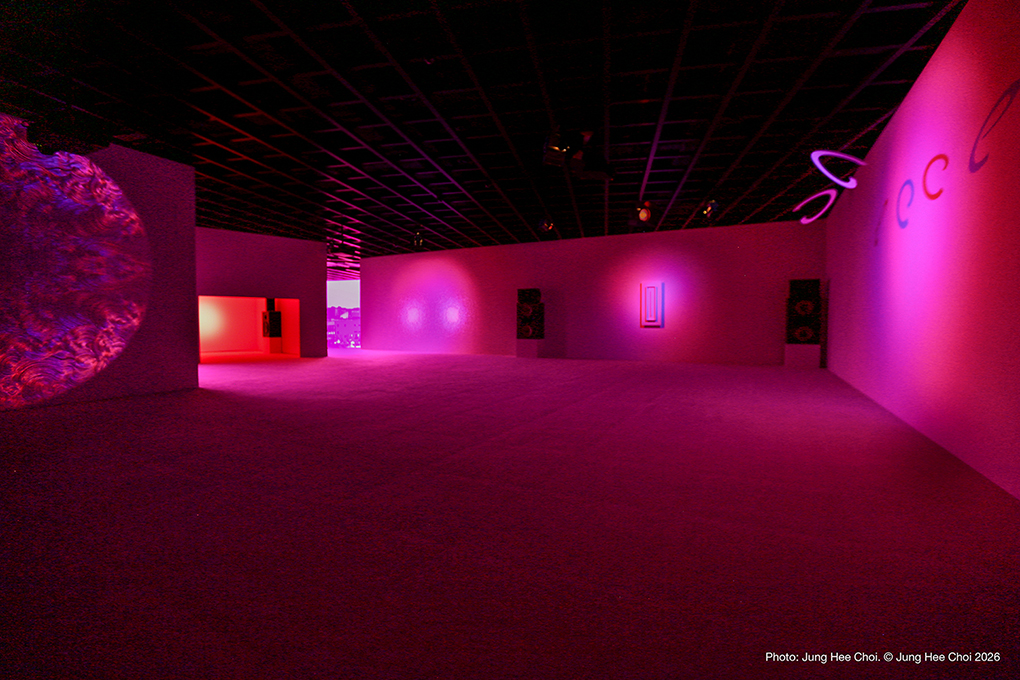
Each Dream House is uniquely designed based on the architectural structure of the exhibition site, making every sound and light environment a distinct work with its own shape and dimensions. This version of Dream House incorporates the new configuration of the Young and Choi simultaneous sound environment with the Zazeela and Choi simultaneous light environment, demonstrating the ongoing evolution of Dream House, a work with the capacity to propel itself by its own momentum.
"The Base 9:7:4 Symmetry" and "Tonecycle" sound environment is another example of a Young and Choi collaborative sound work projecting the opposite paradigms in complementarity, where two sound environments will be simultaneous and harmonizing in one acoustic space, allowing the listener to experience the complex interrelationship of these two sets of intervallic frequency ratios. The sine waves in Young's The Base 9:7:4 Symmetry consist of long-sustained tones that remain constant and sound eternally without any change. In her writing, Choi articulates the opposing natures of the two sound environments. She explains:
Young's sound environment in the Dream House contains complex intervallic ratios of continuous sine waves that would theoretically sound eternally, without any aspiration toward melody or rhythm. The long, sustained tones are locked and remain constant, projecting a sense of eternal stasis. However, even the smallest and unavoidable actions of the listener, such as breathing or blinking, change the perception of the tones. With the human body, the audience can never fully experience the absolute constancy of the work. In contrast, the sine wave frequencies in my sound environment, Tonecycle Base 30 Hz, 2:3:7, are constantly revolving and never stand in any one place long enough to satisfy the definition of a traditional musical pitch. The motion of the tones is extremely slow and, therefore, the sense of pitch shift is practically imperceptible. Yet because the tones move at a constant speed in the same direction and the relationships among corresponding frequencies remain relativistically invariant, they create the aural illusion that the frequencies of the tones remain unchanged. Over time, the interactions of these slow-moving sine waves give rise to the gradual emergence of distinctive melodic and rhythmic patterns, produced not by thematic development but by the acoustic phenomenon of phase interference. By presenting my imperceptibly yet continuously moving frequencies together with Young's fixed frequency constant, it becomes possible for the listener to perceive the movement of my frequencies in time.In the light environment, Zazeela presents four works: animated calligraphy, Imagic Light (1993), Ruine Window from Still Light (1992) and environment, Magenta Day / Magenta Night, Leeum (1993, 2026), and Neon, Dream House Variation II (1990). Together with Zazeela, Choi presents three light installation works: RICE in the Magenta Field (1999, 2021) 108 x 2 Sine Wave Matrix (G/R) for Tonecycle for Blues Base 30 Hz, 2:3:7 with 4:3 and 7:6 (2016, 2026), and Time Crystals (2026).
La Monte Young pioneered the concept of extended time durations in 1957 and for over 60 years contributed extensively to the development of just intonation and rational number-based tuning systems in his performance works and the periodic composite sound waveform environments of the Dream House collaborations formulated in 1962 with Marian Zazeela. Presentations of his work in the U.S. and Europe, as well as his theoretical writings gradually had a wide-ranging influence on contemporary music, art and philosophy, including Minimalism, concept art, Fluxus, performance art and conceptual art. In L.A. in the '50s, Young played jazz saxophone, leading a group with Billy Higgins, Dennis Budimir and Don Cherry. He also played with Eric Dolphy, Ornette Coleman, Terry Jennings, Don Friedman, and Tiger Echols. At Yoko Ono's studio in 1960 he was director of the first New York loft concert series. He was the editor of An Anthology, which with his Compositions 1960 became a primary influence on concept art and the Fluxus movement. In 1962 Young founded his group The Theatre of Eternal Music and embarked on The Tortoise, His Dreams and Journeys, a large work involving improvisation within strict predetermined guidelines. Young and Zazeela helped bring renowned master vocalist Pandit Pran Nath to the U.S. in 1970 and became his first Western disciples. Described by Mark Swed in his October 2009 Los Angeles Times blog as "pure vibratory magic," Young's Just Alap Raga Ensemble, founded in 2002 with Zazeela and their senior disciple Jung Hee Choi, has become his primary performance vehicle. "For the past quarter of a century he has been the most influential composer in America. Maybe in the world." (Los Angeles Herald Examiner, 1985). "As the acknowledged father of minimalism and guru emeritus to the British art-rock school, his influence is pervasive" (Musician magazine, 1986). "Young is now widely recognized as the originator of the most influential classical music style of the final third of the twentieth century." (Strickland, Minimalism:Origins, 1993). "La Monte Young: Le Son du Siècle." (L'Express L'An 2000 Supplement, 1999).
Marian Zazeela is one of the first contemporary artists to use light as a medium of expression. Expanding the traditional concepts of painting and sculpture while incorporating elements of both disciplines, she developed an innovative visual language in the medium of light by combining colored light mixtures with sculptural forms to create seemingly three-dimensional colored shadows in radiant vibrational fields. Zazeela began singing in 1962 with La Monte Young as a founding member of The Theatre of Eternal Music, and performed as vocalist in almost every concert of the ensemble to date, in addition to creating the visual components of Dream House, their collaborative sound and light work. Her major work, The Magenta Lights, has been described in Art Forum as representing "the subtle relationship between precision and spirituality. [She] transforms material into pure and intense color sensations, and makes a perceptual encounter a spiritual experience." With Young in 1970, she brought Pandit Pran Nath to the U.S. and became one of his first Western disciples. She has since performed and taught the Kirana style of Indian classical music and accompanied Pandit Pran Nath in hundreds of concerts throughout the world. Zazeela's distinctive calligraphic style appears on many of Pran Nath's concert posters and recordings. Zazeela's Ornamental Lightyears Tracery has been credited by Glenn Branca in Forced Exposure #16, 1990, and by David Sprague in Your Flesh # 28, 1993, to have been the direct influence on Warhol's Exploding Plastic Inevitable. The Village Voice listed the [Church Street] Dream House as the Best Art Installation in New York 2014, "A charge for the mind as much as for the eye and ear, the Dream House feels like a gift to our beleaguered city, where headspace is the most precious real estate of all." Zazeela continued to perform as a vocalist until 2018 in The Just Alap Raga Ensemble and The Sundara All Star Band, which she founded with Young and Jung Hee Choi. In 2021 Zazeela was honored as one of the 14 artists to receive the prestigious Anonymous Was A Woman Award in recognition of her significant contributions. Zazeela's rarely-seen master works on paper were featured at Dia:Beacon from 2019 to 2022, and most recently at Zazeela's graphic work and abstract calligraphic drawings, spanning from 1962 through 2003, were on view at Artists Space in New York until May 11, 2024.
Jung Hee Choi is an artist and musician recognized for her extensive series of environmental compositions that explore the concept of "Ahata Anahata, Manifest Unmanifest" (2007- ). This series encompasses a diverse array of multimedia installations that integrate light, sound, evolving light-point drawings, incense and performance. The New York Times highlighted Choi's installation, Ahata Anahata, Manifest Unmanifest IX, at Dia 15 VI 13 on West 22nd Street, NYC, "With extended listening, what at first seemed mechanically repetitious turns out to be a complex interweaving of different, slowly oscillating pitches. If you give in to it while watching Ms. Choi's hallucinatory screen, you may find yourself in an altered state of consciousness, on the verge of some ineffable, transcendental revelation." Her video sound performance and installation, RICE, commissioned by MELA Foundation, received acclaim as one of the "10 Best of 2003" in the December issue of Artforum. In 1999, Choi became a disciple of La Monte Young and Marian Zazeela in the study of music and art, with the classical Kirana tradition gandha bandh red-thread ceremony on March 28, 2003. In 2002, she co-founded, with Young and Zazeela, The Just Alap Raga Ensemble, and followed this with the formation of The Sundara Trio in 2009. In 2015, Choi premiered her electroacoustic and modal improvisation ensemble, The Sundara All Star Band. The members include Young, Zazeela, Choi, Jon Catler, Hansford Rowe and Naren Budhkar. The New York Times featured Choi's Tonecycle for Blues performed by her Sundara All Star Band as one of The Best Classical Music Performances of 2017. Since 2009, Choi's long-term multimedia installations have been presented both solo and simultaneously with Young and Zazeela's sound and light in the MELA Dream House, creating a continuous collaborative environment. Choi graduated with a B.A. summa cum laude and received an M.A. in art and sound from New York University. Since 2008 Choi has taught raga at the Kirana Center for Indian Classical Music, New York.