
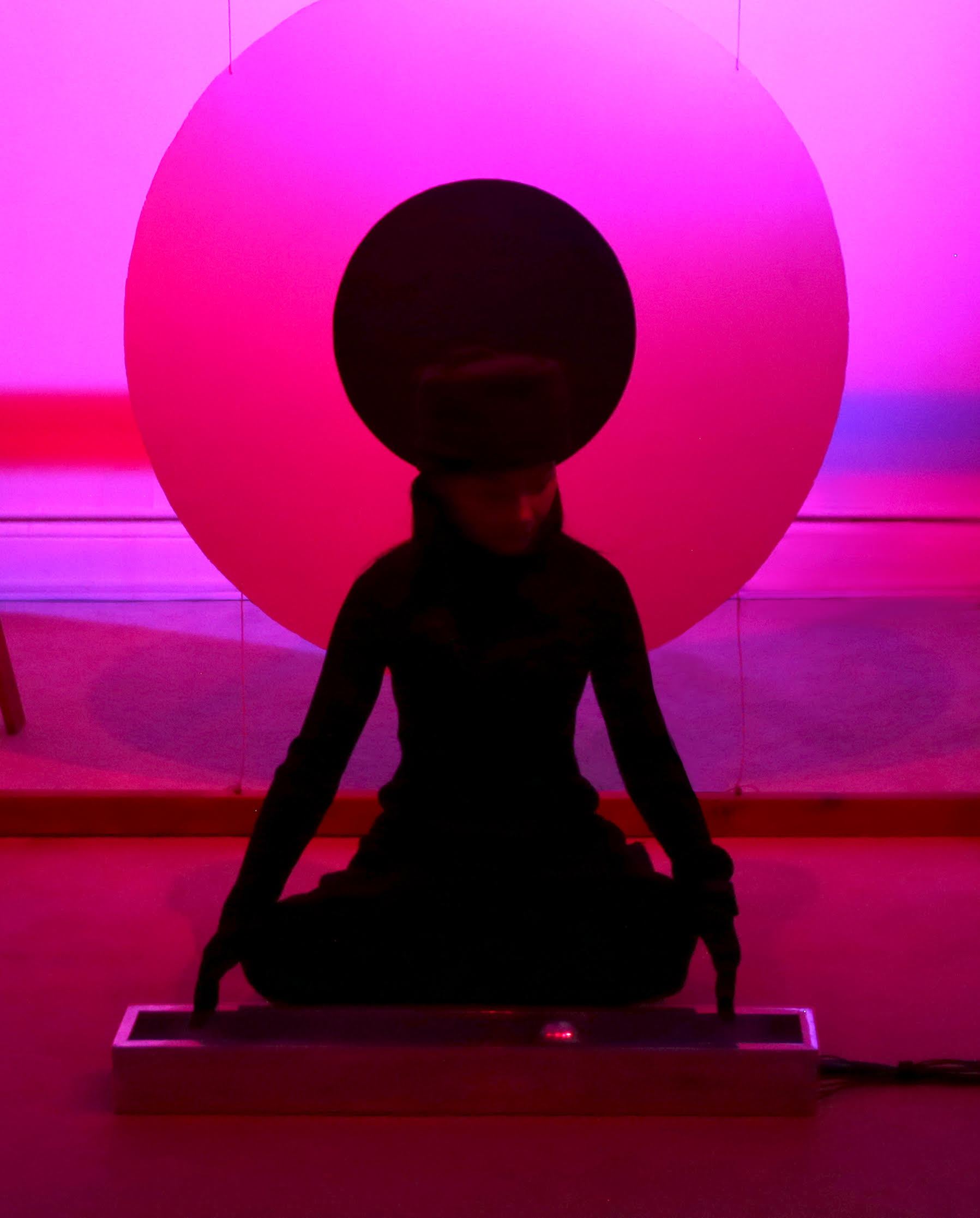
 Jung Hee Choi performing Seven on Walter De Maria's Instrument for La Monte Young; MELA
Foundation Dream House
Jung Hee Choi performing Seven on Walter De Maria's Instrument for La Monte Young; MELA
Foundation Dream House
JUNG HEE CHOI
Seven (2024, 2026)
on
Walter De Maria
Instrument for
La Monte Young (1966)
Performed by Jung Hee Choi
LA MONTE YOUNG
Studies in the Bowed Disc (1963)
on
Robert Morris
Gong for La Monte Young (1963)
Performed by Jung Hee Choi and Julia Kim
Saturday, September 5, 2026 · 6 pm GMT
Leeum 26 IV 29 Seoul Dream House
Reservations: https://www.leeumhoam.org/leeum/edu/program/1718
Leeum Museum of Art
Inside Other Spaces: Environments by Women Artists
1956-1976
60-16, Itaewon-ro 55-gil, Yongsan-gu, Seoul, 04348, Korea
On September 5, 2026, two works by La Monte Young and Jung Hee Choi—one historic and the other receiving its
premiere—will be presented in the Leeum 26 IV 29 Seoul Dream at the Leeum Museum of Art in Seoul,
Korea, in
conjunction with
Inside Other Spaces: Environments by Women Artists, 1956-1976.
The performance centers on Instrument for La Monte Young (1966) and Gong for La Monte Young (1963), two sculptural works and unconventional metal instruments created and dedicated to La Monte Young (b. 1935) by artists Walter De Maria (1935-2013) and Robert Morris (1931-2018), respectively, who played significant roles in the development of Minimalism and Conceptual Art in the 1960s. These two works can be regarded as significant examples that encapsulate the 1960s avant-garde's pursuit of expanding across artistic media and rethinking the boundaries between art and life. Seven (2024, 2026), composed by Jung Hee Choi and performed on De Maria's Instrument for La Monte Young, harmonically rescales the instrument through a pre-recorded digital sound montage derived from its natural resonances and real-time digital processing generated by Choi’s own algorithm. La Monte Young’s Studies in the Bowed Disc (1963), composed for Robert Morris’s Gong for La Monte Young, is a seminal work constructed from sustained sounds produced through friction. Its 1964 recording, performed by Young and Marian Zazeela, became an influential reference point for noise music and a cult classic of post-Minimalist psychedelia and sound art. The performance offers a rare opportunity to witness and experience the conceptual and immersive dimensions of instruments conceived by and for some of the most influential figures in postwar avant-garde art and musicmusic, presented within Dream House, one of the most important sound-and-light environments—a work that continues to evolve across generations.
The performance centers on Instrument for La Monte Young (1966) and Gong for La Monte Young (1963), two sculptural works and unconventional metal instruments created and dedicated to La Monte Young (b. 1935) by artists Walter De Maria (1935-2013) and Robert Morris (1931-2018), respectively, who played significant roles in the development of Minimalism and Conceptual Art in the 1960s. These two works can be regarded as significant examples that encapsulate the 1960s avant-garde's pursuit of expanding across artistic media and rethinking the boundaries between art and life. Seven (2024, 2026), composed by Jung Hee Choi and performed on De Maria's Instrument for La Monte Young, harmonically rescales the instrument through a pre-recorded digital sound montage derived from its natural resonances and real-time digital processing generated by Choi’s own algorithm. La Monte Young’s Studies in the Bowed Disc (1963), composed for Robert Morris’s Gong for La Monte Young, is a seminal work constructed from sustained sounds produced through friction. Its 1964 recording, performed by Young and Marian Zazeela, became an influential reference point for noise music and a cult classic of post-Minimalist psychedelia and sound art. The performance offers a rare opportunity to witness and experience the conceptual and immersive dimensions of instruments conceived by and for some of the most influential figures in postwar avant-garde art and musicmusic, presented within Dream House, one of the most important sound-and-light environments—a work that continues to evolve across generations.
JUNG HEE CHOI
Seven (2024, 2026)
on
Walter De Maria
Instrument for
La Monte Young (1966)
Composed and performed by Jung Hee Choi
using Walter De Maria's sculptural Instrument for La Monte Young (1966),
with pre-recorded digital sound montage and real-time digital processing
Seven (2024, 2026)
on
Walter De Maria
Instrument for
La Monte Young (1966)
Composed and performed by Jung Hee Choi
using Walter De Maria's sculptural Instrument for La Monte Young (1966),
with pre-recorded digital sound montage and real-time digital processing
This premiere will present both a period instrument and a newly forged set of associations, with Jung Hee
Choi
performing solo on the Instrument for La Monte Young, an audible sculpture designed and built in
1966
by Young's
early close colleague Walter De Maria (1935-2013). La Monte Young himself never performed it in public; he
later
personally invited his senior disciple, Jung Hee Choi, to compose a piece for the instrument. Consisting of
an oblong, rectangular metal box enclosing a rolling metal ball and fitted with contact microphones, the
Instrument amplifies the rattling friction and resonant rumble of metal against metal as the ball moves back and
forth within the enclosure. In her piece (entitled
Seven for
its focus on the seventh harmonic and for its use of the number seven as a constant function to extend the
duration of microsounds as the primary thematic and formal element), Choi routes the tactile sounds of the
Instrument through a modern digital processor governed by an algorithm of her own devising. Drawing on an
analysis of the Instrument's spectral content, she identified two prominent resonant frequencies
forming the
harmonic ratio 41:23 and wove them into the composition as seven continuous sine waves spanning three octaves at
a subliminal amplitude, which, though barely perceptible themselves, serve to reinforce the resonant frequencies
of the Instrument.
LA MONTE YOUNG
Studies in the Bowed Disc (1963)
on
Robert Morris
Gong for
La Monte Young (1963)
Performed by Jung Hee Choi and Julia Kim
using the gong designed and constructed by Robert Morris (1963)
In this program, history is present both in the legacy of composer La Monte Young and in the metallic body of
the original four-foot-diameter gong dedicated to Young by artist Robert Morris (1931–2018). Composed in 1963,
Studies in The Bowed Disc explores the gong’s dense, multidimensional field of vibration through
sustained
bowing with double bass bows. Although the vibrational modes of plates and disks are conventionally understood
to be inharmonic, Young’s performance practice brings forth unexpectedly consonant, harmonically suggestive
low-frequency pitch fields within the instrument’s resonance. Subsequent realizations of the work include 23
VIII 64 2:50:45–3:11 AM The Volga Delta, recorded by Young and Marian Zazeela in their New York studio in
1964
and originally released as Side B of the celebrated Black Record. In that performance, Young and
Zazeela bowed
opposite sides of the gong, setting its vibrations into motion. The recording rapidly became e an important
reference point for the 1960s avant-garde and its continuing legacy. In recent years, Young and Jung Hee Choi
have renewed this historic work through a series of revelatory realizations, bringing its resonant field into
the present. At Leeum, Studies in The Bowed Disc will again be realized as a duet, with Jung Hee Choi
and Julia
Kim bowing opposite sides of the gong.
La Monte Young
is a foundational figure in contemporary music and American minimalism. His radical vision reshaped the
postwar avant-garde and has exerted a far-reaching influence on Fluxus, experimental music, ambient drone, and
psychedelic music. For over sixty-five years, he has advanced durational musical composition and explored the
psychological and phenomenological effects of precise tuning in periodic composite sound waveform
environments. In 1962, Young and his lifetime collaborator and partner, Marian Zazeela, founded the
influential group The Theatre of Eternal Music and embarked on The Tortoise, His Dreams and Journeys
(1964– ), a large-scale work involving improvisation within strictly predetermined guidelines. With an
evolving membership that included Terry Riley, Angus MacLise, Tony Conrad, and John Cale, the group developed
a radical performance practice centered on sustained sound, drone, improvisation, and harmonic relationships.
In 1970, Young and Zazeela supported Indian master vocalist Pandit Pran Nath’s journey to the United
States, spending twenty-six years as his disciples in the Kirana style of Indian classical singing. In 1962,
Young formulated the concept of a Dream House, realized in 1966 with Zazeela. Nearly forty Dream
House installations have been presented internationally. The MELA Foundation Dream House has remained
open
since 1993 at 275 Church Street in New York, where Young continues to perform with The Theatre of Eternal
Music and The Just Alap Raga Ensemble, founded in 2002 with Zazeela and their senior disciple Jung Hee
Choi.
Musician magazine stated, “As the acknowledged father of minimalism and guru emeritus to the
British art-rock school, his influence is pervasive,” and in 1985 the Los Angeles Herald
Examiner wrote, “for the past quarter of a century he has been the most influential composer in
America. Maybe in the world.” In Minimalism: Origins, 1993, Edward Strickland
added, “Young is now widely recognized as the originator of the most influential classical music style
of the final third of the twentieth century.” In 2020, The New York Times referred to
Young as “The Man Who Brian Eno Called ‘the Daddy of Us All’: La Monte Young, the Composer
Who Quietly Shaped Much of Contemporary Western Music.”
Marian Zazeela A seminal artist in the New York avant-garde and Minimalist movements, Zazeela is renowned for her pioneering work with light and her calligraphic abstract drawings. Over the course of more than six decades, she developed a singular vision across diverse media. She played a pivotal role in the emergence of intermedia and environmental art by establishing a visual vocabulary for The Theatre of Eternal Music and Dream House, created in collaboration with her lifelong partner, composer La Monte Young. Zazeela began singing with Young in 1962 as a founding member of The Theatre of Eternal Music. In 1970, she became one of the first Western disciples of the renowned master vocalist Pandit Pran Nath, later performing and teaching the Kirana style of Indian classical music. She accompanied Pandit Pran Nath in hundreds of concerts throughout the world and also performed with The Just Alap Raga Ensemble and The Sundara All Star Band. Zazeela’s work has been highly influential. Her abstract calligraphy was a primary influence on the work of Angus MacLise, the great poet and founding drummer of The Theatre of Eternal Music and the Velvet Underground. The visionary tradition of her curvilinear calligraphic drawings has also been carried forward and developed to a highly imaginative level by her visual-arts and raga disciple, Jung Hee Choi. Zazeela’s Ornamental Lightyears Tracery has been credited as a direct influence on Warhol’s Exploding Plastic Inevitable. Artforum wrote of Zazeela’s light installation: “Zazeela transforms material into pure and intense color sensations, and makes a perceptual encounter a spiritual experience. The Magenta Lights is an environmental piece in every sense of the word. What Zazeela has represented is the subtle relationship between precision and spirituality.” In 2021, Zazeela was honored as one of fourteen artists to receive the prestigious Anonymous Was A Woman Award, in recognition of her significant contributions. Zazeela’s installations, works on paper, and performances have been presented by major American and European institutions, most recently at Dia Beacon from 2019 to 2022 and at Artists Space, New York, in 2024.
Jung Hee Choi is an artist and musician whose practice encompasses sound, light, performance, and site-responsive installation. She is recognized for Ahata Anahata, Manifest Unmanifest, a series of evolving environmental compositions. Through infinitesimally shifting patterns of sound and light, Choi creates durational fields of vibration that The New York Times described: "If you give in to it while watching Ms. Choi's hallucinatory screen, you may find yourself in an altered state of consciousness, on the verge of some ineffable, transcendental revelation."A senior disciple of La Monte Young and Marian Zazeela in the classical Kirana vocal tradition, Choi has, since 2003, presented her installations both as solo works and in collaboration with Young and Zazeela in the Dream House Sound and Light Environments. Together, they co-founded The Just Alap Raga Ensemble in 2002 and have performed extensively in various configurations, including The Sundara Trio, The Sundara All Star Band, and The Theatre of Eternal Music. The New York Times featured Choi's Tonecycle for Blues, performed by her electroacoustic and modal improvisation ensemble, The Sundara All Star Band, as one of the Best Classical Music Performances of 2017. Choi has taught North Indian raga at the Kirana Center for Indian Classical Music since 2008. She has also served as visiting faculty in the Music/Sound MFA program at Bard College, curated festivals, produced experimental television, and published on sound, cosmology, and contemporary music. Since 2015, Choi's work has become integral to the Dream House, where it is presented in simultaneous complementarity with the compositions of Young and Zazeela. Her work expands the Dream House as a cross-generational and continuously unfolding genre, extending its temporal, perceptual, and existential dimensions. Choi has exhibited and performed internationally at Casa del Lago UNAM, Dia Art Foundation, the Solomon R. Guggenheim Museum, Berliner Festspiele, FRESH Festival in Bangkok, FRAC Franche-Comté, and the Bundeskunsthalle.
Julia Kim engages phenomenological processes through the body, material systems, and the environments they inhabit—approaching sound and light as active, evolving, and sculptural forces rather than fixed forms. From gutter downspout pipes that are amplified and translated into resonant feedback instruments to CRT televisions transmitting found imagery from a U.S. Army base in South Korea, looping audiovisual elements recur throughout her installations and performances, creating shifting conditions of repetition and perception. Common materials, mediated images, and acoustic phenomena become sites to examine how memory is embodied and transformed through extended modes of observation. Kim is currently a student of Jung Hee Choi, with the MELA Foundation Dream House acting as a sustained influence in her field of artistic inquiry. Recipient of the Dean’s Award for Innovation in Time-Based Media, Kim graduated from The Cooper Union for the Advancement of Science and Art with a Bachelor of Fine Arts and a minor in the History and Theory of Art.
Marian Zazeela A seminal artist in the New York avant-garde and Minimalist movements, Zazeela is renowned for her pioneering work with light and her calligraphic abstract drawings. Over the course of more than six decades, she developed a singular vision across diverse media. She played a pivotal role in the emergence of intermedia and environmental art by establishing a visual vocabulary for The Theatre of Eternal Music and Dream House, created in collaboration with her lifelong partner, composer La Monte Young. Zazeela began singing with Young in 1962 as a founding member of The Theatre of Eternal Music. In 1970, she became one of the first Western disciples of the renowned master vocalist Pandit Pran Nath, later performing and teaching the Kirana style of Indian classical music. She accompanied Pandit Pran Nath in hundreds of concerts throughout the world and also performed with The Just Alap Raga Ensemble and The Sundara All Star Band. Zazeela’s work has been highly influential. Her abstract calligraphy was a primary influence on the work of Angus MacLise, the great poet and founding drummer of The Theatre of Eternal Music and the Velvet Underground. The visionary tradition of her curvilinear calligraphic drawings has also been carried forward and developed to a highly imaginative level by her visual-arts and raga disciple, Jung Hee Choi. Zazeela’s Ornamental Lightyears Tracery has been credited as a direct influence on Warhol’s Exploding Plastic Inevitable. Artforum wrote of Zazeela’s light installation: “Zazeela transforms material into pure and intense color sensations, and makes a perceptual encounter a spiritual experience. The Magenta Lights is an environmental piece in every sense of the word. What Zazeela has represented is the subtle relationship between precision and spirituality.” In 2021, Zazeela was honored as one of fourteen artists to receive the prestigious Anonymous Was A Woman Award, in recognition of her significant contributions. Zazeela’s installations, works on paper, and performances have been presented by major American and European institutions, most recently at Dia Beacon from 2019 to 2022 and at Artists Space, New York, in 2024.
Jung Hee Choi is an artist and musician whose practice encompasses sound, light, performance, and site-responsive installation. She is recognized for Ahata Anahata, Manifest Unmanifest, a series of evolving environmental compositions. Through infinitesimally shifting patterns of sound and light, Choi creates durational fields of vibration that The New York Times described: "If you give in to it while watching Ms. Choi's hallucinatory screen, you may find yourself in an altered state of consciousness, on the verge of some ineffable, transcendental revelation."A senior disciple of La Monte Young and Marian Zazeela in the classical Kirana vocal tradition, Choi has, since 2003, presented her installations both as solo works and in collaboration with Young and Zazeela in the Dream House Sound and Light Environments. Together, they co-founded The Just Alap Raga Ensemble in 2002 and have performed extensively in various configurations, including The Sundara Trio, The Sundara All Star Band, and The Theatre of Eternal Music. The New York Times featured Choi's Tonecycle for Blues, performed by her electroacoustic and modal improvisation ensemble, The Sundara All Star Band, as one of the Best Classical Music Performances of 2017. Choi has taught North Indian raga at the Kirana Center for Indian Classical Music since 2008. She has also served as visiting faculty in the Music/Sound MFA program at Bard College, curated festivals, produced experimental television, and published on sound, cosmology, and contemporary music. Since 2015, Choi's work has become integral to the Dream House, where it is presented in simultaneous complementarity with the compositions of Young and Zazeela. Her work expands the Dream House as a cross-generational and continuously unfolding genre, extending its temporal, perceptual, and existential dimensions. Choi has exhibited and performed internationally at Casa del Lago UNAM, Dia Art Foundation, the Solomon R. Guggenheim Museum, Berliner Festspiele, FRESH Festival in Bangkok, FRAC Franche-Comté, and the Bundeskunsthalle.
Julia Kim engages phenomenological processes through the body, material systems, and the environments they inhabit—approaching sound and light as active, evolving, and sculptural forces rather than fixed forms. From gutter downspout pipes that are amplified and translated into resonant feedback instruments to CRT televisions transmitting found imagery from a U.S. Army base in South Korea, looping audiovisual elements recur throughout her installations and performances, creating shifting conditions of repetition and perception. Common materials, mediated images, and acoustic phenomena become sites to examine how memory is embodied and transformed through extended modes of observation. Kim is currently a student of Jung Hee Choi, with the MELA Foundation Dream House acting as a sustained influence in her field of artistic inquiry. Recipient of the Dean’s Award for Innovation in Time-Based Media, Kim graduated from The Cooper Union for the Advancement of Science and Art with a Bachelor of Fine Arts and a minor in the History and Theory of Art.